
Beyond E-Learning: How to Turn AI Training for Employees Into Real Workplace Adoption
September 2026
Most organisations can point to a completed rollout of AI training for employees: certificates issued, completion dashboards showing green across the board. Far fewer can point to their people working differently six weeks later.
Across every sector, businesses are investing heavily in AI tools, and it is easy to understand why. The opportunity in front of them is significant, from the hours handed back to teams every week, to the customer problems that can now be solved at a scale which simply was not commercially realistic two years ago. Alongside that investment, most are rolling out vast amounts of e-learning to bring their people with them.
The reality inside those organisations is more complicated. Many are dealing with real problems around uptake and engagement. Employees complete the modules, then go on to use the tools inconsistently and at a very basic level, without the confidence to get anything close to the full value from them. And the measures being used to judge whether any of it has worked are the wrong ones, because completion tells you people showed up, not whether the work changed.
Completion tells you people showed up. It doesn’t tell you whether the work changed.
E-learning is essential, but not sufficient
Let’s be clear: e-learning still matters. It’s accessible, consistent and scalable, especially across large or distributed organisations, and it gives everyone a shared starting point for talking about AI and using it responsibly. Without that foundation, nothing else stands a chance.
But a course was never meant to be the whole strategy. Knowing what generative AI is differs from knowing when, where and how to use it responsibly in a live workflow. That’s the gap where most training budgets disappear: real spend, with little visible change in how people work day to day.
E-learning builds awareness and capability and implementation turns that capability into everyday behaviour.
Why AI training often fails to transfer
If you’ve rolled out AI training and watched adoption stall, you’ll recognise these barriers.
The learning is too generic
A finance manager, a customer-support agent and a marketer all need different examples and applications. Generic content leaves employees unable to connect what they’ve learned to their own role or the friction they deal with every day.
Employees lack permission and clarity
People are often unsure what data can and can’t go in, which tools are approved, what needs a human review, and who to escalate to. Broad warnings without clear boundaries tend to create hesitation, not safe confidence.
There is no immediate chance to apply learning
Learners return to the same workflows and the same deadlines, and the course content fades fast. Teams need a clear first task to practise on, not a certificate and a shrug.
Managers are not equipped to reinforce it
Managers often don’t know what good AI use looks like on their team: what to encourage, what to ask about in a one-to-one, or when to simply protect time for people to experiment. Without visible reinforce
ment from leadership, AI learning starts to feel optional.
Success is measured only by completion
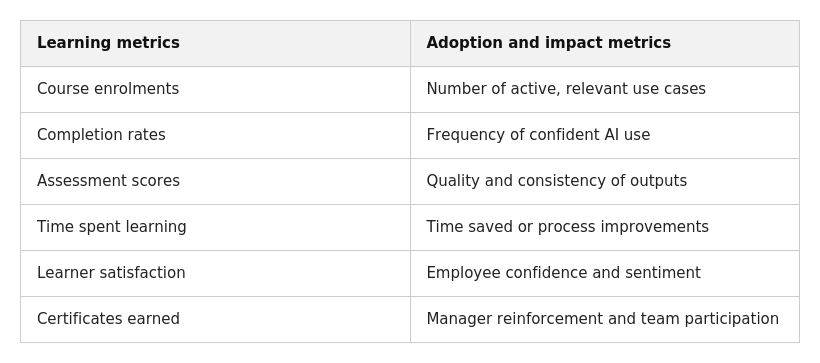
Completion rates, quiz scores and attendance all matter, but none of them show whether people are applying skills effectively. Organisations need measures that reflect real adoption and operational value, not just attendance.
The shift: from course completion to capability in action
Closing that gap means treating implementation as part of the learning design, not an afterthought bolted on after the certificate is issued.
Think about it almost like an AI Adoption Loop:
-
- Learn: Build the foundational knowledge and confidence to use AI responsibly.
-
- Apply: Give learners a relevant, low-risk task to use AI on straight away.
-
- Share: Create structured moments for teams to compare notes: what’s working, what still feels risky.
-
- Improve: Encourage learners to refine their outputs and tighten the workflow around them.
-
- Standardise: Turn what’s working into a documented, repeatable way of working.
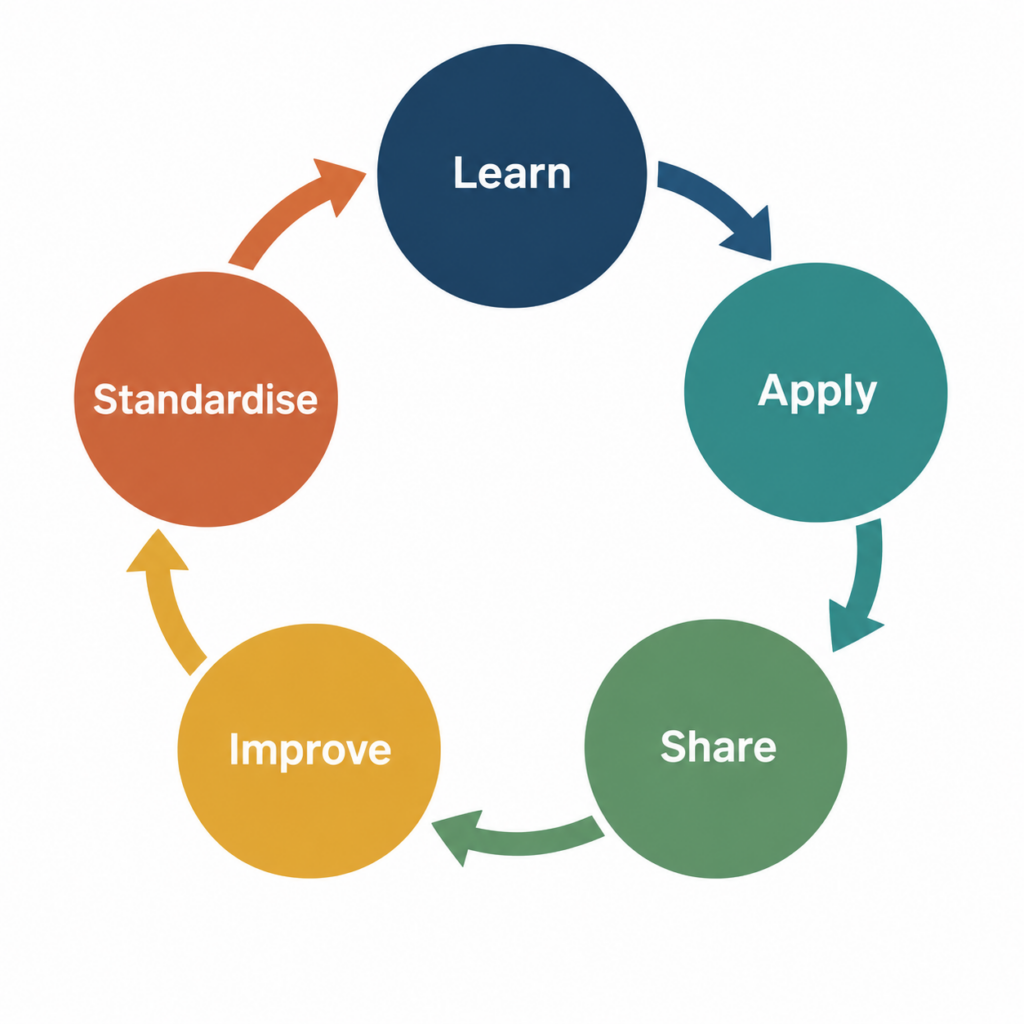 Then it starts again. Each pass through the loop makes the habit a little more automatic, and a little less effortful.
Five ways to make AI learning stick
1. Start with real work, not tool features
Identify the repetitive, time-consuming or high-friction tasks people already deal with, and teach AI as the way to get through them faster. Focus on t
he job to be done, not the newest feature. Instead of teaching “how to u
se an AI writing assistant,” help a customer-service team turn common enquiry themes into first-draft responses, using approved information, human review and clear quality checks.
2. Build learning around roles and use cases
Adapt your examples and scenarios to the learner’s actual work. Build pathways by department or job family, and prioritise the AI use cases that matter to that team’s real work, not just the ones that are easy to demo.
3. Give people a safe space to practise
Small, repeated experiments tend to work better than a single large rollout, every time. Provide templates, scenarios and review criteria, and make it clear that responsible use includes checking outputs and knowing when not to use AI at all.
4. Equip managers to reinforce it
Give managers practical conversation prompt
s: what did you try, what worked, what needs refining? Help them recognise useful AI applications and protect time for their teams to learn.
5. Reinforce learning after the course
Keep it alive after the course with post-course challenges, team discussions, nudges, office hours and peer examples. Treat the first 30 days after training as an implementation period in its own right, not the point where the process ends.
What should organisations measure?
Learning metrics tell you people showed up. Adoption metrics tell yo
u whether it worked.
Before any of this means anything, you need a starting point. If nobody measured how often people were using AI, or how confident they felt doing it, before training began, there’s nothing to compare the after picture against. A baseline doesn’t need to be elaborate: a short pulse survey or a look at current tool usage is enough.
Not every organisation needs to measure everything at once. The best first step is choosing a small set of indicators that connects AI learning to a priority business outcome, and building from there.
Where Upskill Universe fits in
At Upskill Universe, we build AI training around the Adoption Loop above: learning that’s specific to the role, a real task to apply it to straight away, and the manager and team follow-through that turns a course into a habit.
We work with enterprise teams and small businesses on the same principle either way: a workforce that knows where AI adds value and uses it responsibly is worth more than a stack of completed certificates.
That follow-through happens because a person is involved in what they’re learning and not because they’ve learned terminology and systems by heart. Our training runs through a global network of human coaches, which is exactly the kind of reinforcement this piece argues most AI training is missing.
Make implementation part of the learning plan
E-learning is still a solid foundation. But AI adoption at scale needs a plan for what happens before, during and after the course, not just the course itself. The organisations that build in workflow application and reinforcement are the ones that turn training spend into real capability.
The finish line that matters is a workforce that knows where AI adds value, uses it responsibly, and reaches for it without being told to.
Planning an AI learning rollout? Speak to Upskill Universe about building the implementation plan alongside it, so people move from AI awareness to everyday use.